Case · Backend · Python
cron-clock: cron explained and next runs
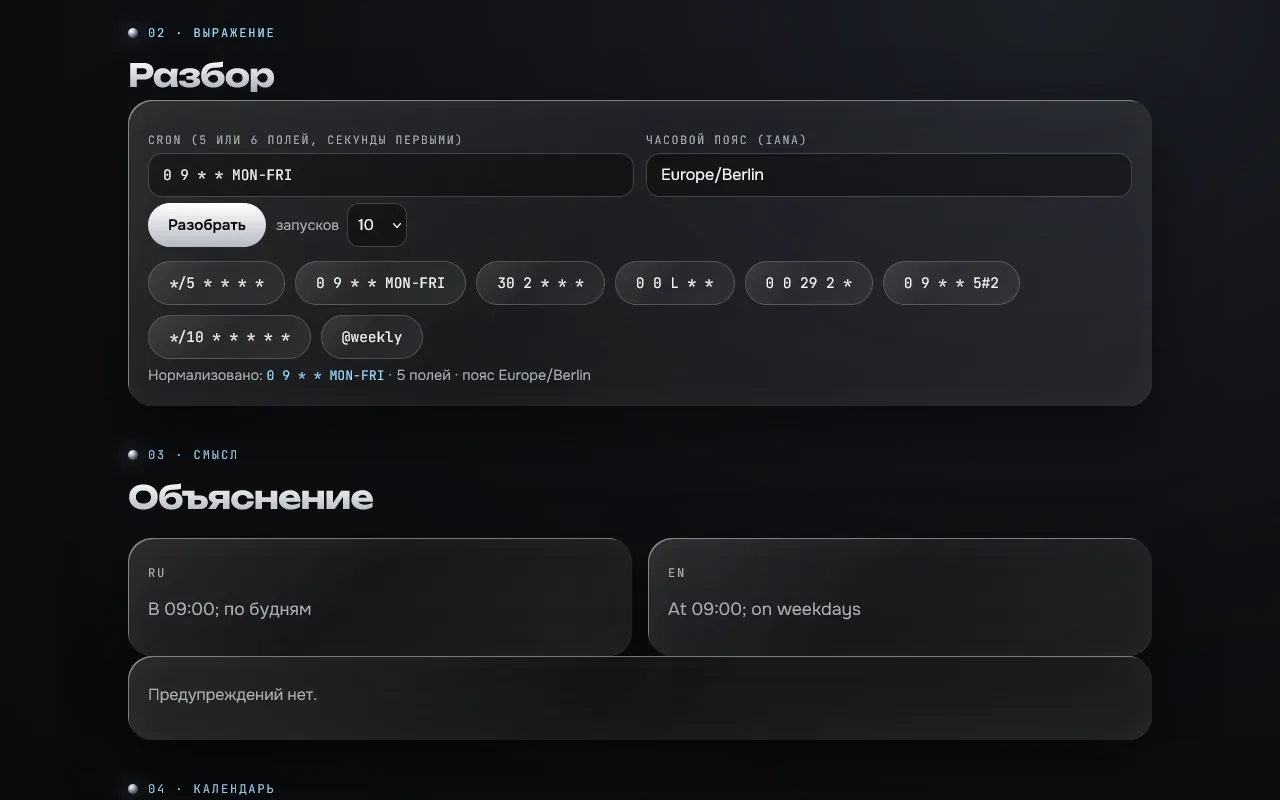
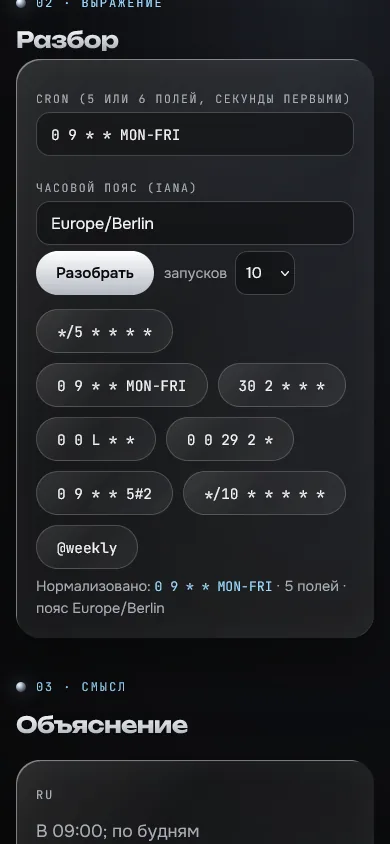
A cron-expression service in Python (FastAPI, standard library and zoneinfo only). It explains an expression in Russian and English, computes the next runs in a given time zone with daylight saving transitions, warns about "dangerous" schedules and compares two expressions. L, W, # and six fields with seconds are supported.
- Python
- FastAPI
- uvicorn
- zoneinfo
- hypothesis
- mypy --strict
- ruff
- pip-audit
- Docker
- GitHub Actions
01 · How it looks
Screenshots
02 · About
What it is and why
A cron-expression service in Python (FastAPI, standard library and zoneinfo only). It explains an expression in Russian and English, computes the next runs in a given time zone with daylight saving transitions, warns about "dangerous" schedules and compares two expressions. L, W, # and six fields with seconds are supported.
Limitations
Weekday numbering follows standard cron (Sunday is 0 or 7), not Quartz; the seventh year field is unsupported.
@reboot is rejected: it has no schedule.
The DST rules are deliberately simple; a real cron (Vixie, systemd timers, Quartz) may behave differently.
The project runs on a small VPS with demo data: no redundancy or backups.
What is inside
- Next runs across DST: the Europe/Berlin boundaries of 2024-03-31 and 2024-10-27, Lord Howe with its half-hour shift
- 64 tests; hypothesis with 150 examples per property: a run satisfies the expression, no matching minute is skipped (checked by brute force)
- Comparing `* * * * * *` against `* * * * *` over 400 days in 0.6 s
- /api/parse: about 800 requests per second, p95 35 ms; 37 MiB RAM idle
03 · How to run
Run it locally
git clone <repository on request> cron-clock
cd cron-clock
python -m app04 · Code
The repository is private
The source is in a private repository. Message me on Telegram and I will open access.
Request the code